Check out our Coaching Blog here:
Featured Articles
Stop Sounding Like a Template: The Personal Branding vs. Personal Summary Showdown
Stop Sounding Like a Template: The Personal Branding vs. Personal Summary Showdown
Let’s be honest for a second: most resumes read like they were written by the same exhausted AI bot from 2022.
You know the vibe. "Motivated, results-oriented professional with 10 years of experience seeking a challenging role in a dynamic environment."
Yawn.
If I had a nickel for every time I saw that exact sentence during my 11 years as a senior recruiter, I wouldn’t be writing this blog, I’d be retired on a private island somewhere sipping something with a tiny umbrella.
The truth is, sounding like everyone else is the fastest way to get ignored by recruiters. You aren't just a collection of "bullet points" and "passionate adjectives." You’re a high-performing professional with a unique set of battle-tested skills.
But here is where the confusion starts. People often use "Personal Brand" and "Personal Summary" interchangeably. They aren't the same thing. In fact, understanding the difference is the secret sauce to becoming the candidate companies fight over.
Today marks the first day of our Daily Module Drop Week, and we’re kicking things off with the ultimate showdown: Personal Branding vs. Personal Summary.
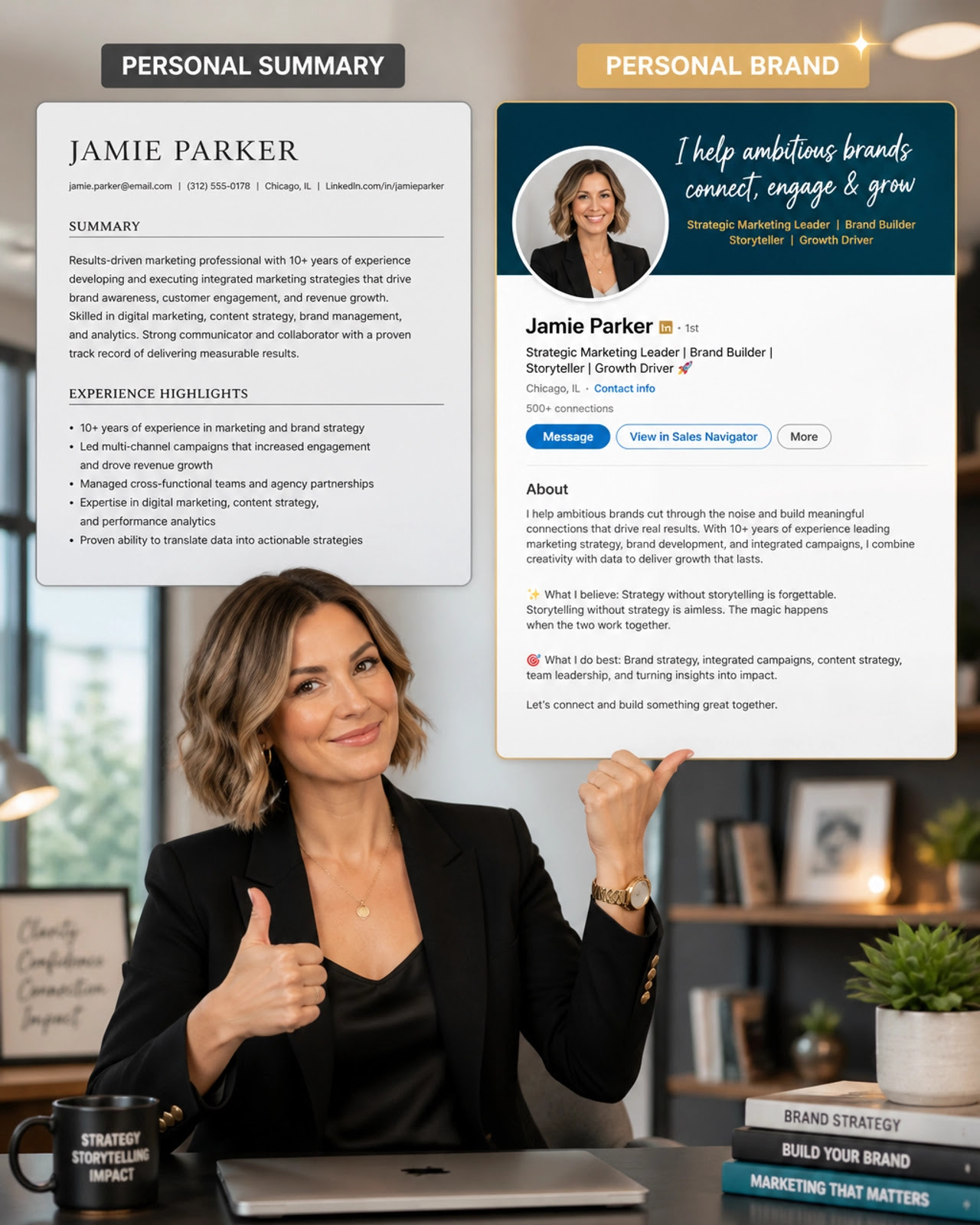
The Personal Summary: Your 6-Second First Impression
Think of your Personal Summary as the "fast match" check.
When a recruiter (like the old version of me) opens your resume, they aren't looking for your life story. They are looking for a reason not to hit "delete." They have about 6 to 10 seconds to decide if you’re worth a deeper look.
The summary, that 3-to-5 line block at the top of your resume, is your elevator pitch. It’s role-specific. It’s tight. It’s designed to say: "I am exactly what you’re looking for for this specific job."
Why it’s great:
Precision: It mirrors the language of the job description (hello, ATS optimization).
Speed: It gives the recruiter the "highlights reel" immediately.
Direction: It tells the reader exactly which bucket you belong in.
The Personal Brand: Your Long-Term Signal
If the summary is the "fast match," your Personal Brand is the long-term signal.
Your brand is the overall professional story and reputation you build across LinkedIn, your portfolio, and even how you interact in the comments of a post. It’s the "vibe" someone gets when they Google your name.
While a summary is a snapshot, a brand is a narrative. It answers the question: "Who is this person really? Do they seem credible, and why should I trust them over the other 500 applicants?"
Recruiters use your brand to verify the claims you made in your summary. If your resume summary says you’re a "strategic leader," but your LinkedIn brand is non-existent or, worse, inconsistent, the trust is broken.
Why it’s great:
Trust: It builds credibility before you even hop on a screening call.
Differentiation: It highlights your personality, values, and how you solve problems: things a bullet point can’t do.
Inbound Interest: A strong brand makes recruiters come to you. (This is the goal, right?)
The Showdown: Brand vs. Summary
So, which one wins? Neither. They are partners in your success.
Imagine your job search as a high-end restaurant. The Personal Summary is the menu outside the door that catches a hungry person's eye. The Personal Brand is the decor, the service, and the quality of the food that makes them want to stay, pay, and come back.
You need both to win the "Executive Glow-Up."
Stop Being "The Template Person"
I see it every day. Talented professionals who are absolute beasts at their jobs, but their online presence looks like a blank "Coming Soon" page.
If your LinkedIn profile is just a copy-paste of your resume duties, you aren't branding: you're just duplicating.
(Boring, right? It’s like watching a movie trailer that is just a list of the actors' names. Give us some plot!)
To truly stand out, you have to move beyond the summary and start curating a brand. You need to show proof, not just slogans.
Instead of saying you’re a "collaborative manager," show us a LinkedIn post where you highlight a win for your team. Instead of listing "Python" as a skill, feature a GitHub project or a case study in your LinkedIn "Featured" section.
The Glow-Up: Module Drop #1 is LIVE
I know, I know. "Branding" sounds like a full-time job. You’re busy actually doing the work; you don't have time to become a marketing guru.
That’s where I come in. I’ve done the heavy lifting for you. I’ve taken 11+ years of recruiter data and ICF-accredited coaching frameworks and condensed them into a single, punchy module.
Introducing Module #1: Personal Branding vs. Personal Summary.
This isn't a "Top 10 Tips" list you can find on Google. This is the battle-tested playbook for professionals who are ready to take full ownership of their narrative.
What’s inside:
The "Anti-Template" Summary Formula: How to write a resume header that stops the scroll.
The LinkedIn Identity Audit: A step-by-step guide to aligning your brand with your target role.
Scripted Success: Real-world examples of how to pivot from "job seeker" to "industry authority."
The Trust Filter: Boring but important: how to ensure your privacy settings and public profile aren't accidentally ghosting recruiters. (Think of it as a clean break from your old, invisible self).
The Catch (There’s Always a Catch)
I’m dropping a new module every single day this week. But here is the deal: these modules are only available for two weeks.
The clock is ticking. On June 26th, these specific modules disappear from the shop. They go back into the vault, and the special discounted price goes with them.
Why? Because I value action. I want to work with motivated mid-to-senior level professionals who are ready to execute. If you’re the type of person who bookmarks things and "gets to them later," this isn't for you. But if you’re ready for a career glow-up right now, this is your moment.
[GET THE MODULE: Personal Branding vs. Personal Summary HERE] (https://ultimateedgecareerservices.com/modules)
What's Coming This Week?
This is just Day 1. We’re going to be streamlining your entire search process over the next few days. Keep an eye on your inbox (or this blog) for:
The 30-Day Job Search Calendar
The Ultimate Networking Playbook (no more awkward small talk)
The Salary Negotiation Mastery (get paid what you're worth)
Job Search Tracking Sheet
LinkedIn - Make your LinkedIn POP
If you have questions about the modules or aren't sure where to start, reach out. We’re here to be your partner-in-success. Email us at info@ultimateedgecareerservices.com.
Stop sounding like a template. Start sounding like a leader.
Let's get to work.

Stop Sounding Like a Template: The Personal Branding vs. Personal Summary Showdown
Stop Sounding Like a Template: The Personal Branding vs. Personal Summary Showdown
Let’s be honest for a second: most resumes read like they were written by the same exhausted AI bot from 2022.
You know the vibe. "Motivated, results-oriented professional with 10 years of experience seeking a challenging role in a dynamic environment."
Yawn.
If I had a nickel for every time I saw that exact sentence during my 11 years as a senior recruiter, I wouldn’t be writing this blog, I’d be retired on a private island somewhere sipping something with a tiny umbrella.
The truth is, sounding like everyone else is the fastest way to get ignored by recruiters. You aren't just a collection of "bullet points" and "passionate adjectives." You’re a high-performing professional with a unique set of battle-tested skills.
But here is where the confusion starts. People often use "Personal Brand" and "Personal Summary" interchangeably. They aren't the same thing. In fact, understanding the difference is the secret sauce to becoming the candidate companies fight over.
Today marks the first day of our Daily Module Drop Week, and we’re kicking things off with the ultimate showdown: Personal Branding vs. Personal Summary.
The Personal Summary: Your 6-Second First Impression
Think of your Personal Summary as the "fast match" check.
When a recruiter (like the old version of me) opens your resume, they aren't looking for your life story. They are looking for a reason not to hit "delete." They have about 6 to 10 seconds to decide if you’re worth a deeper look.
The summary, that 3-to-5 line block at the top of your resume, is your elevator pitch. It’s role-specific. It’s tight. It’s designed to say: "I am exactly what you’re looking for for this specific job."
Why it’s great:
Precision: It mirrors the language of the job description (hello, ATS optimization).
Speed: It gives the recruiter the "highlights reel" immediately.
Direction: It tells the reader exactly which bucket you belong in.
The Personal Brand: Your Long-Term Signal
If the summary is the "fast match," your Personal Brand is the long-term signal.
Your brand is the overall professional story and reputation you build across LinkedIn, your portfolio, and even how you interact in the comments of a post. It’s the "vibe" someone gets when they Google your name.
While a summary is a snapshot, a brand is a narrative. It answers the question: "Who is this person really? Do they seem credible, and why should I trust them over the other 500 applicants?"
Recruiters use your brand to verify the claims you made in your summary. If your resume summary says you’re a "strategic leader," but your LinkedIn brand is non-existent or, worse, inconsistent, the trust is broken.
Why it’s great:
Trust: It builds credibility before you even hop on a screening call.
Differentiation: It highlights your personality, values, and how you solve problems: things a bullet point can’t do.
Inbound Interest: A strong brand makes recruiters come to you. (This is the goal, right?)
The Showdown: Brand vs. Summary
So, which one wins? Neither. They are partners in your success.
Imagine your job search as a high-end restaurant. The Personal Summary is the menu outside the door that catches a hungry person's eye. The Personal Brand is the decor, the service, and the quality of the food that makes them want to stay, pay, and come back.
You need both to win the "Executive Glow-Up."
Stop Being "The Template Person"
I see it every day. Talented professionals who are absolute beasts at their jobs, but their online presence looks like a blank "Coming Soon" page.
If your LinkedIn profile is just a copy-paste of your resume duties, you aren't branding: you're just duplicating.
(Boring, right? It’s like watching a movie trailer that is just a list of the actors' names. Give us some plot!)
To truly stand out, you have to move beyond the summary and start curating a brand. You need to show proof, not just slogans.
Instead of saying you’re a "collaborative manager," show us a LinkedIn post where you highlight a win for your team. Instead of listing "Python" as a skill, feature a GitHub project or a case study in your LinkedIn "Featured" section.
The Glow-Up: Module Drop #1 is LIVE
I know, I know. "Branding" sounds like a full-time job. You’re busy actually doing the work; you don't have time to become a marketing guru.
That’s where I come in. I’ve done the heavy lifting for you. I’ve taken 11+ years of recruiter data and ICF-accredited coaching frameworks and condensed them into a single, punchy module.
Introducing Module #1: Personal Branding vs. Personal Summary.
This isn't a "Top 10 Tips" list you can find on Google. This is the battle-tested playbook for professionals who are ready to take full ownership of their narrative.
What’s inside:
The "Anti-Template" Summary Formula: How to write a resume header that stops the scroll.
The LinkedIn Identity Audit: A step-by-step guide to aligning your brand with your target role.
Scripted Success: Real-world examples of how to pivot from "job seeker" to "industry authority."
The Trust Filter: Boring but important: how to ensure your privacy settings and public profile aren't accidentally ghosting recruiters. (Think of it as a clean break from your old, invisible self).
The Catch (There’s Always a Catch)
I’m dropping a new module every single day this week. But here is the deal: these modules are only available for two weeks.
The clock is ticking. On June 26th, these specific modules disappear from the shop. They go back into the vault, and the special discounted price goes with them.
Why? Because I value action. I want to work with motivated mid-to-senior level professionals who are ready to execute. If you’re the type of person who bookmarks things and "gets to them later," this isn't for you. But if you’re ready for a career glow-up right now, this is your moment.
[GET THE MODULE: Personal Branding vs. Personal Summary HERE] (https://ultimateedgecareerservices.com/modules)
What's Coming This Week?
This is just Day 1. We’re going to be streamlining your entire search process over the next few days. Keep an eye on your inbox (or this blog) for:
The 30-Day Job Search Calendar
The Ultimate Networking Playbook (no more awkward small talk)
The Salary Negotiation Mastery (get paid what you're worth)
Job Search Tracking Sheet
LinkedIn - Make your LinkedIn POP
If you have questions about the modules or aren't sure where to start, reach out. We’re here to be your partner-in-success. Email us at info@ultimateedgecareerservices.com.
Stop sounding like a template. Start sounding like a leader.
Let's get to work.